More Than the Sum of Its Parts
Linking flows to add value
My Role
Design an end-to-end user flow. Investigation, refining the user experience, and supporting developers to realise the end goal.
Foundation Enhancement: This project demonstrates the ability to improve existing design systems and create elegant solutions within technical constraints — deeply understanding how systems work together to design intuitive navigation.
The Problem
Getting separate products talking
The NovaHub SaaS product includes multiple components supplied to clients.
The complex nature of individual products means they are ready at differing times and scales.
These products, although architected to work together, were not yet fully integrated.
The largest pain point: users downloading a list of customer IDs from one product and uploading them back onto the system to use another product on the same platform.
User Experience Impact: This manual process created friction, increased error risk, and prevented users from efficiently leveraging data across features. The goal was to enable seamless cross-feature data usage within the same platform.
Multiple Flows
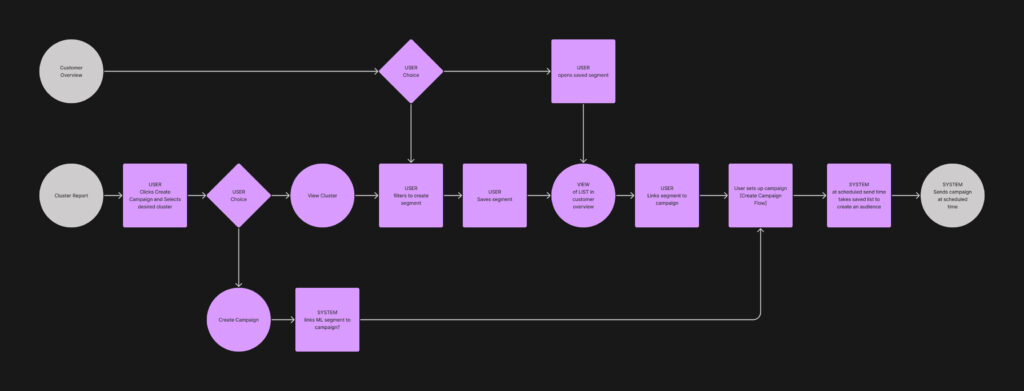
With multiple products on the platform, each has its own user flows leading to an output:
- Machine Learning product which clusters users to find receptivity levels
- Customer database that filters user attributes
- Campaign manager for scheduling emails, pop-ups, notifications, SMS and incentives
We also needed to account for future flows that could be added.
Gathering Information
I set up workshops with team leaders to understand how products could communicate.
When designing I explore possibilities and generate ideas for near-future expansions — kept realistic to what can be done in the next 6 months after MVP delivery. This helps teams plan ahead, reducing refactoring.
Alongside those sessions, user flows and wireframes were drawn to illustrate happy paths. I also used the design system to build out ideas and facilitate ideation.
Strategic Approach: The integration was always planned, but I had to work around technical limitations and find elegant solutions — balancing user needs with technical constraints while maintaining design system consistency.
Scaling Down
the Feature
Incremental feature delivery
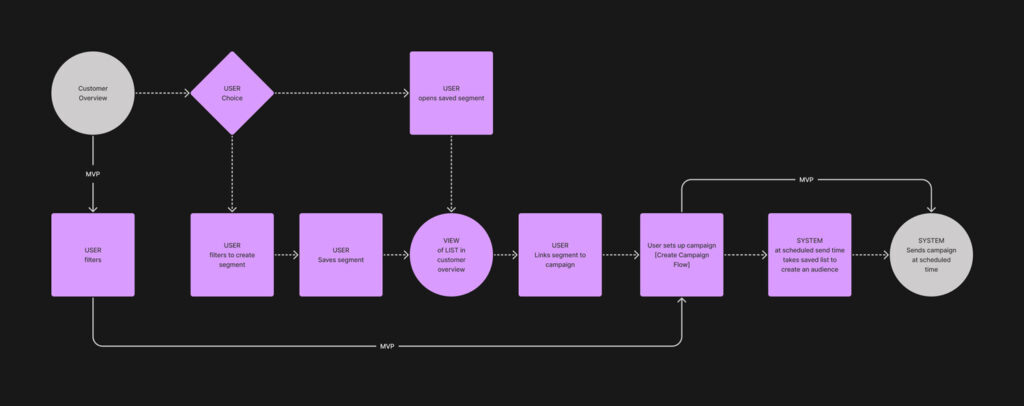
The feature is scaled down to an MVP — a joint effort between Developers, Product Owners and Design.
We prioritise and trade off features to decide what brings the most impact in terms of value and shorter timeframes.
In this case: take the filtered user list output and use that information inside the campaign manager.
Rapid Prototyping
Using the Design System
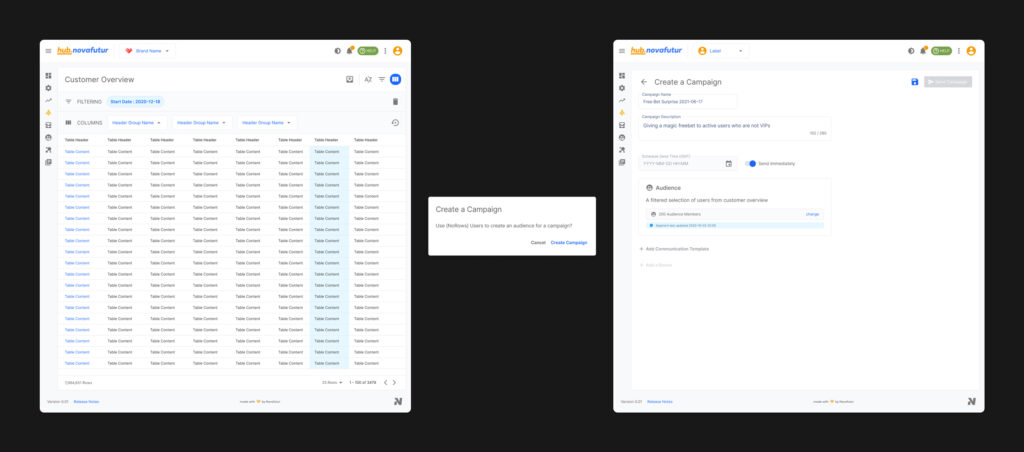
Ideas from brainstorming sessions are assembled into mid-fidelity prototypes to test user flows in detail.
Using the design system I'm able to rapid-prototype and test ideas with peers.
Breaking &
Expanding Flows
Stress testing the design
We test the design and flow looking for flaws and pain points, refining and testing again.
End-to-end flows are built out to find holes in the loops. Error possibilities and handling strategies are discussed.
Testing
High-fidelity testing
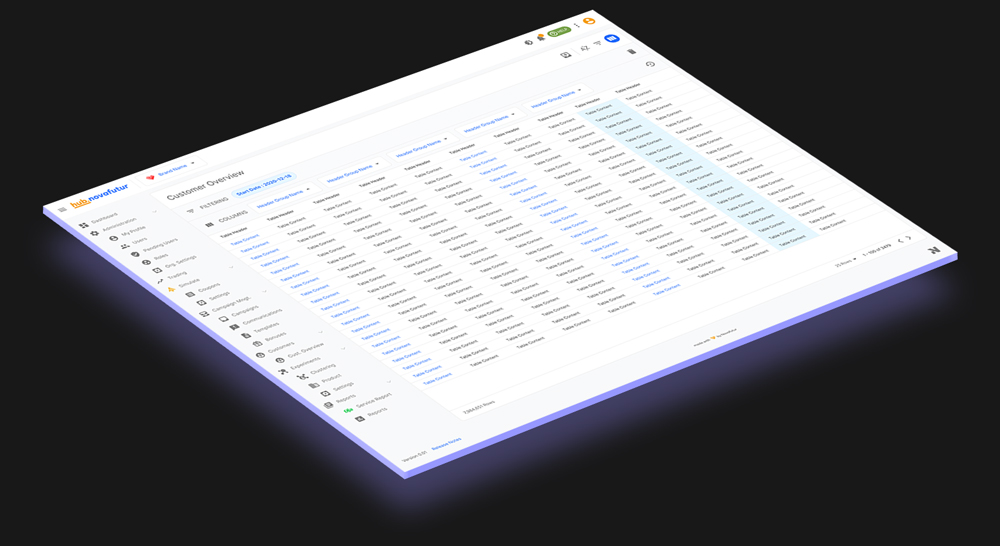
Final UI designs are produced. This stage helped us find potentially unseen problems for our target audience with varying levels of experience.
Refinements &
Refactoring
Teaming up with developers
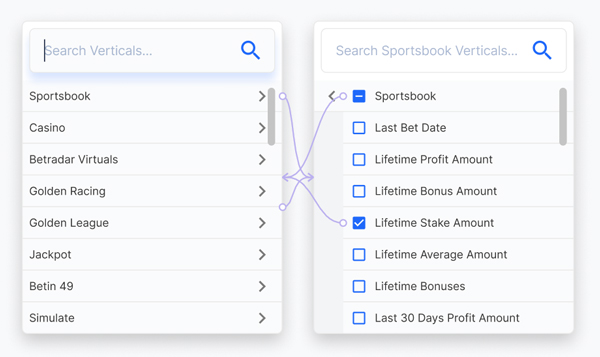
After designing to a stable agreed vision, I supported the front-end development team in refining the interface and repurposing older components. New components had their flows and design patterns fully built out.
Takeaways
Smaller increment releases helped us stay focused on user needs. There's a danger in over-designing — you could plan complex products that don't add much user value.
The approach: continuously build, improve, and keep teams in sync. This allows us to react to client demands and market trends.
In this project I learned that all team members should define the end goal together, while understanding that changes along the way are how we continuously deliver value.
User Success: The integration enabled users to seamlessly use data across features. Feedback indicated the solution was easier to use and significantly reduced mistakes.
Foundation Enhancement: This project showcases the ability to improve existing design systems by understanding technical constraints and creating solutions that enhance workflows without compromising system integrity.